
How can historic fortifications become part of a modern city? How can we give them new functions whilst preserving their historical value? And how can the experiences of different cities help to further develop our fortification heritage? The international conference FORTRESS RE – USED. Heritage – Community – Tourism, organised on 24 September by the Tourism Department of Municipality of Kraków at Fort 52a Jugowice, centred on these issues. The event took place as part of the SCT HUB project – Codesign the Future of Sustainable Cultural Tourism.
The meeting provided a forum for the exchange of experiences between representatives of towns and cities, cultural institutions, organisations involved in fortress heritage, the academic community and the tourism sector from Poland and other European countries. The event was also attended by representatives from the partner cities of the SCT HUB project: Alba Iulia, Venice and Braga.
The conference was opened by Natalia Kulec-Greń, Director of the Tourism Department of Municipality of Kraków, who presented Krakow Fortress as one of the key elements in achieving the objectives of the “A Sustainable Tourism Policy for Krakow in the Years 2021-2028”. She emphasised that modern tourism requires a shift away from thinking solely in terms of visitor numbers towards the quality of experiences, benefits for local residents and the responsible management of tourist flows.
As she pointed out, Krakow Fortress and the SCT HUB project converge on the same principle – an approach based on co-creation, shared responsibility and the involvement of residents in shaping the city’s future. It is precisely the social dimension of heritage and cooperation between different communities that will determine the sustainability and value of the initiatives undertaken. As the sites are spread across the whole of Krakow, Krakow Fortress can also help to diversify tourist traffic and encourage visitors to explore lesser-known parts of the city.
Director Kulec-Greń also highlighted the “Krakow Fortress” tourism product, which has been consistently developed and encompasses promotional and educational activities, as well as events enabling both tourists and local residents to explore the fortifications. She emphasised the importance of cooperation between municipal institutions, organisations and partners involved in the preservation and promotion of the heritage of the fortification system. Another important aspect of these initiatives is encouraging local residents to rediscover the forts as places for recreation, education and community activities, rather than merely as monuments associated with military history.
Bartosz Rzońca, Head of the Museum and Centre of the Scout Movement, a branch of the Museum of Krakow, spoke about the current function of the venue where the conference took place. In his speech, he outlined the history of the fort and emphasised that the greatest challenge had only begun once the regeneration work had been completed. The question to be answered was how to return the former military site to the local community and give it a new purpose.
Fort 52a Jugowice currently operates on two fronts simultaneously. On the one hand, it tells the story of Krakow Fortress and its fortification heritage; on the other, it is a space dedicated to the Scout Movement. The venue has become a place for meetings, educational activities and collaboration with the local community, historical re-enactors and youth groups. As has been emphasised, the presence of people and their activities transform this former military site into a place dedicated to education, integration and the building of social bonds.
The joint presentation was given by Dr Krzysztof Wielgus, Eng. Arch., a researcher and populariser of Krakow Fortress affiliated with the Krakow University of Technology, and Marcin Paradyż, Director of the Municipal Buildings Department in Krakow. The first part presents the development of Krakow Fortress against the backdrop of the history of European fortifications, as well as the scale of the preserved heritage, comprising dozens of buildings and extensive green spaces.
Dr Wielgus pointed out that Krakow Fortress is one of the most valuable and best-preserved fortification complexes in this part of Europe, and that its significance extends far beyond the city’s boundaries. He emphasised the importance of maintaining the continuity of the work carried out by numerous municipal institutions and community groups over recent decades, which has made it possible not only to preserve historic buildings but also to gradually give them new functions and meanings. He also highlighted the need for further international cooperation and the exchange of experiences between European fortresses.
The second part of the presentation focused on specific examples of the adaptation and regeneration of fortifications in Krakow. The discussion covered, amongst other things, Fort Jugowice, Fort Borek, the bastions of Fort Kościuszko, Fort Mistrzejowice, and plans relating to the ongoing refurbishment of Fort St Benedict. The speakers emphasised that each building requires an individual approach, and that the success of regeneration depends on skilfully combining heritage conservation with new social, educational, cultural or recreational functions.
Karolina Cynkar, Head of the Office of The Przemyśl Fortress District and Municipal Association, spoke about her experiences relating to the conservation of one of Europe’s largest fortification systems. She outlined the long-standing process of cooperation between local authorities, which have jointly undertaken to protect the scattered fortress heritage.
The speech focused primarily on the process of having The Przemyśl Fortress designated as a Historic Monument. The speaker demonstrated that this success was not the result of a single investment, but of consistent efforts encompassing conservation work, the protection of the sites, infrastructure development, the signposting of routes, and the gradual opening of the forts to local residents and tourists. The importance of cooperation and the involvement of local communities was particularly emphasised.
Dr Katarzyna Pałubska, MSc (Eng), a landscape architect and specialist in cultural heritage management, shared her experiences of preparing the international UNESCO nomination for the Silver Mountain Fortress. Her speech demonstrated that modern heritage conservation requires not only the preservation of the sites themselves, but also the development of effective management systems, cooperation and long-term development strategies.
The speaker discussed in detail the process of establishing an international partnership between fortresses in Poland, Germany and Italy, emphasising the importance of exchanging experiences and developing common standards for heritage conservation. As she pointed out, cooperation makes it possible to overcome limitations and benefit from solutions developed by other partners.
The experiences of Alba Iulia in Romania were presented by Mihail Belală, an adviser in the International Relations and Urban Innovation Department of Municipality of Alba Iulia. He outlined the process of transforming the former fortress from an inaccessible military zone into the city’s most important public space.
Thanks to the use of European funds and a consistently implemented regeneration strategy, the fortress has become a hub for social, cultural and tourist life. As the speaker emphasised, the aim was not merely to protect the historic building, but above all to improve residents’ quality of life and to use the heritage as a catalyst for the town’s development.
Brigida Pagani, Head of the Sustainable Tourism Department in Venice, presented Venice’s experiences, highlighting the transformation of Fort Marghera. A former defensive structure originally built to protect Venice, it has now become a multi-purpose space for culture, education, community organisations and local residents.
The speaker demonstrated how the gradual adaptation of successive buildings and the introduction of new features had made it possible to create a place that is bustling with life all year round. Fort Marghera, situated within the UNESCO World Heritage Site ‘Venice and its Lagoon’, is today one of the most significant examples of the repurposing of military heritage in the region. The fort covers an area of approximately 385,000 m2 and comprises 79 historic buildings. Following the City of Venice’s takeover of the site, a large-scale regeneration programme was launched, with 38 million EUR allocated to the project to date.
The fort is currently home to cultural institutions, non-governmental organisations, a public library, a military museum, museum foundations, spaces for artistic activities, restaurants and community organisations, including Scout groups. The example of Venice has shown how a former military site can be transformed into an open space serving the purposes of culture, education, social integration and the everyday lives of local residents.
Professor Nataša Urošević from the Juraj Dobrila University in Pula, Chair of the Forte Cultura Scientific Advisory Board , spoke about the experiences of Pula in Croatia. She presented the history of the former coastal fortress and the work being done to preserve and promote the Austro-Hungarian fortification heritage on the Adriatic coast.
Particular emphasis was placed on the importance of cooperation networks, joint projects and the exchange of knowledge between towns with a similar heritage. Pula was presented as an example of a city that uses its historic fortifications to develop cultural tourism, educational activities and community initiatives.
Łukasz Pawlik, Director of the Municipal Greenspace Authority in Krakow, spoke about the natural environment of Krakow Fortress. He emphasised that the heritage of Krakow Fortress consists not only of a system of historic fortifications, but also of an extensive network of green spaces, which form an important part of the city’s natural environment. Particular attention was paid to the potential of the 222 hectares of green spaces surrounding Krakow’s fortifications, which serve recreational, educational and nature conservation purposes. At the same time, the entire network of areas associated with the Krakow Fortress covers over 1,000 hectares of green space, forming one of the largest such areas within the city.
The speaker pointed out that, over the course of more than a century since the fortress sites ceased to serve a military purpose, valuable natural habitats and a rich biodiversity have developed there. Contemporary conservation efforts do not, therefore, involve the uncritical reproduction of the historical appearance of buildings, but rather the search for a balance between heritage conservation and nature conservation.
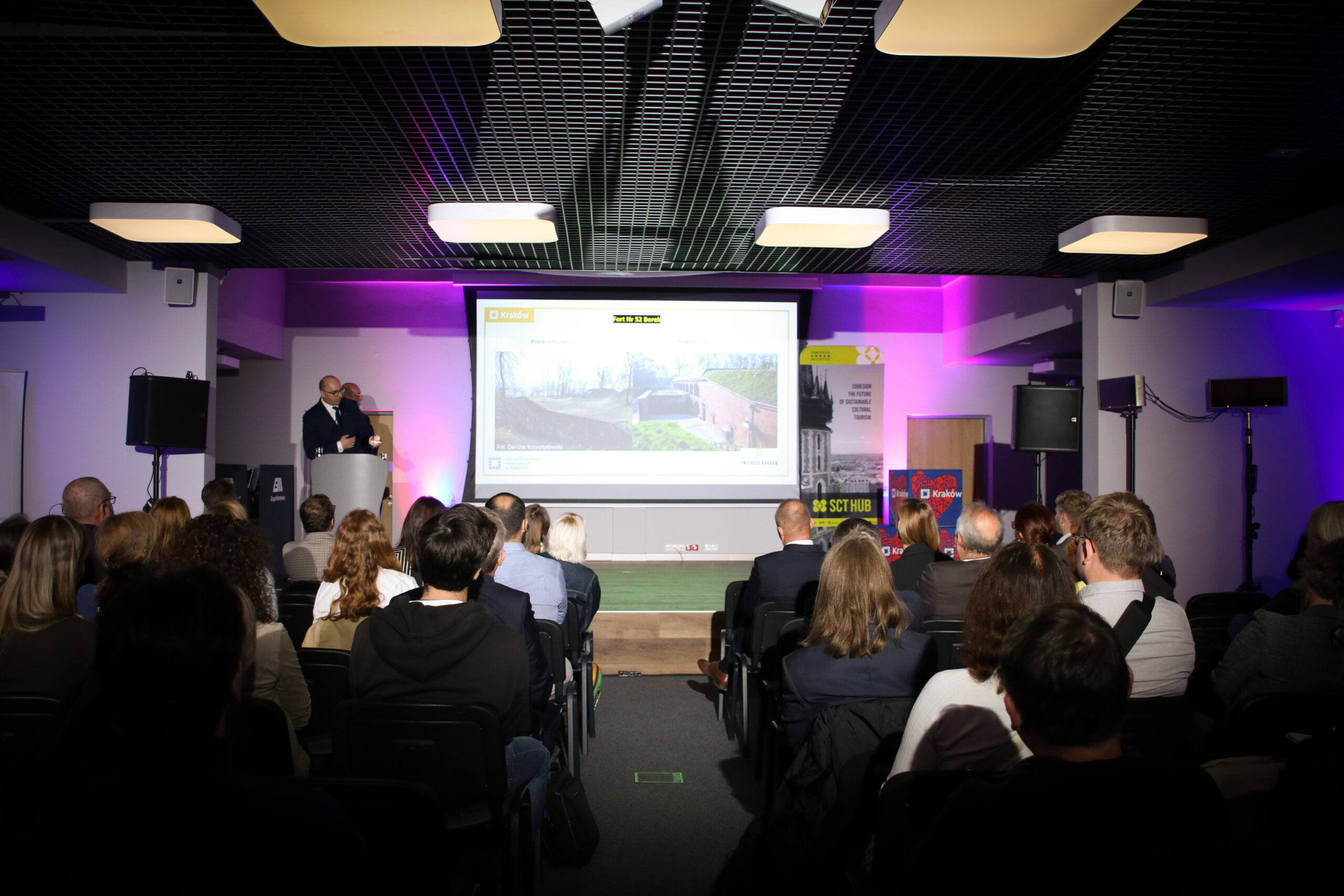
The highlight of the programme was the debate entitled ‘From defence to community: The contemporary role of fortresses’, moderated by Ewelina Pędziwiatr from the Polish Heritage Foundation. The discussion brought together experts and practitioners involved in the conservation, adaptation and management of fortification heritage.
The participants unanimously emphasised that the role of fortresses today goes far beyond that of historic monuments or tourist attractions. Old fortifications are increasingly becoming venues for social gatherings, education, community activities and cultural events. Another important topic was historical memory and the role of fortifications as places for reflecting on the consequences of armed conflicts, fostering dialogue and promoting a culture of peace.
A great deal of attention was paid to the importance of local communities. It was emphasised that even the best-planned project will not be a complete success without the involvement of local residents. It is the residents, community organisations, volunteers and local enthusiasts who are increasingly taking on the role of co-hosts of these former forts, breathing new life into them and giving them new purposes. Revitalisation does not end with the completion of the building works – that is only the beginning of the process of building a lasting relationship between the building and the community.
Another key theme of the discussion was the need to strike a balance between heritage conservation and the contemporary use of these sites. Experts pointed out that historic fortifications should be given functions that meet the needs of residents and users, whilst remaining true to their history and identity. The importance of international cooperation was also emphasised, as it enables cities to draw on the experiences of others, tackle similar challenges together and forge new partnerships.
The debate also repeatedly highlighted the view that Krakow successfully combines preserving its fortifications with giving them new functions, enabling them to serve the local community, culture and tourism. Participants cited Krakow’s experiences as inspiring examples of cooperation between municipal institutions, experts, civil society organisations and residents, aimed at preserving and revitalising the city’s fortification heritage.
The “FORTRESS RE – USED” conference demonstrated that European fortresses, whilst differing in terms of their history, scale and mode of operation, face similar challenges. Heritage conservation, the search for new uses, community involvement, the development of sustainable tourism and international cooperation emerged as common themes across all the presentations and discussions.
The meeting at Fort 52a in Jugowice provided an opportunity not only to showcase best practice, but above all to discuss the processes, management methods and forms of cooperation that enable the fort’s heritage to be effectively protected and developed. It also demonstrated how much can be achieved when the experiences of individual cities become part of a shared European body of knowledge.
The conference was organised by the Tourism Department of Municipality of Kraków as part of the SCT HUB – Codesign the Future of Sustainable Cultural Tourism project, co-funded by the European Urban Initiative programme. The event’s partners were the Municipal Buildings Department in Kraków, the Scout Movement Centre – a branch of the Krakow Museum, and the Małopolska Tourist Organisation.
