29.09.2025
Krakow Night Commission after one year: 19 resolutions, good practices and compromises
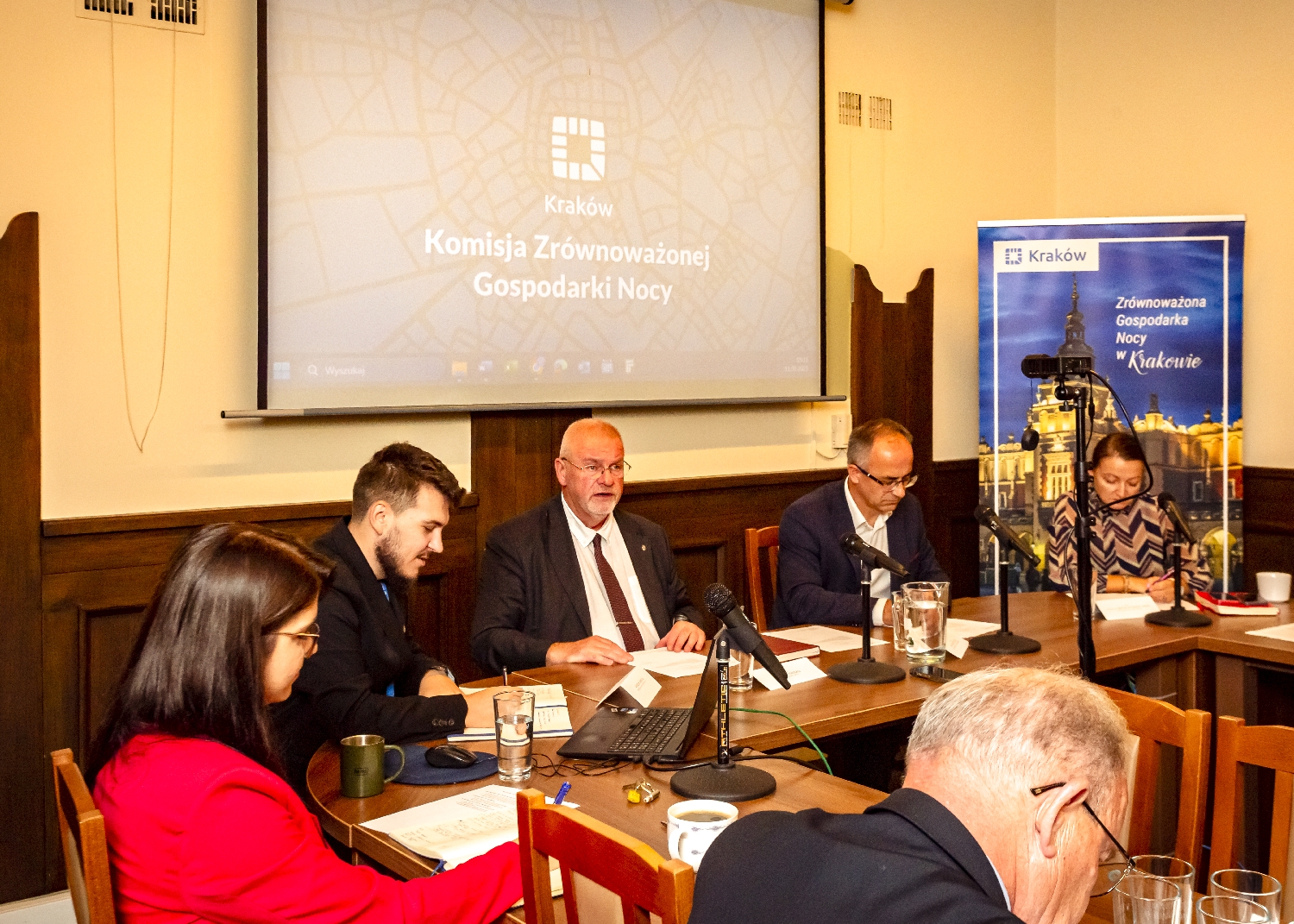
In August 2024, Mayor Aleksander Miszalski appointed a 30-member task force called the Commission on Sustainable Night Economy. It was headed by Krakow’s first Night Mayor, Jacek Jordan.
The Commission was composed of representatives of informal groups of residents, NGOs, uniformed services (police and municipal police), the tourism industry and entrepreneurs, as well as directors of departments of the Municipality of Krakow and municipal companies relevant to the management of the city at night. The members of the Commission perform their functions on a voluntary basis and shall not receive any per diem or remuneration for doing so.
Objectives of the Commission
The task of the Commission on Sustainable Night Economy is to set directions and coordinate activities regarding the functioning of Krakow after dark while taking into account the needs of residents, businesses and visitors. Its remit also includes initiating research, formulating legislative recommendations and cooperating with other cities in Poland and abroad.
A unique team
Dr Robert Pawlusiński, a researcher on the night-time economy from Jagiellonian University, notes that the Commission on Sustainable Night Economy is a unique team on a European scale, bringing together not only representatives of market stakeholders, but also directors of key departments of the Municipality of Krakow and city companies. This allows the Commission’s resolutions and ideas to be implemented more efficiently and effectively.
Key actions of the Commission and Night Mayor
As an advisory body to the Mayor of Krakow, the Commission has made a number of recommendations for changes to national and local law:
- The Commission has drafted a so-called ‘anti-noise’ resolution, providing for a restriction of the use of sound equipment in Krakow between 10 p.m. and 6 a.m., with the exception of premises with adequate acoustic protection and mass events and celebrations. The Krakow City Council took into account the Commission’s postulates by unanimously adopting a broader resolution also covering installations and equipment whose noise may have a negative impact on the environment (Resolution No. XX/465/25).
- A request has been formulated to the central authorities to increase the powers of municipal guards so that guards can complete interventions themselves without having to call the police. This request was forwarded by Mayor Aleksander Miszalski to the Ministry of the Interior and Administration and is on the agenda of the Joint Commission of Government and Local Self-Government.
- An increase in the upper limit of fines was requested. Currently, the municipal police can impose a fine of PLN 500 and this amount has not changed for two decades. The Ministry of the Interior confirmed the rationale for the changes and announced work aimed at identifying opportunities for changes to the law.
- A request has been made to the Ministry of Health and to MPs sitting on the Parliamentary Health Committee to allow municipalities to extend the hours of the ban on night-time retail sales of alcohol to include the morning hours as well – up to 8 a.m. (currently, a municipality can impose such a ban between 10 p.m. and 6 a.m.).
- It was recommended that the rules for the allocation of reserved parking spaces be amended to restrict the possibility of one entity acquiring more than one so-called ‘envelope’ in the inner city and to increase the fee for reserving a parking space. The introduction of such a solution requires the adoption of an appropriate resolution by the City Council.
Measures have also been taken that do not require changes to the law, based on dialogue and consensus among market stakeholders:
- As part of the Commission’s work, a set of good practices was developed for catering entrepreneurs. The document is non-binding but sets desirable standards for the responsible conduct of business, including during night-time hours. The Department of Administrative Affairs has distributed the materials to more than a thousand contractors of the Municipality of Krakow in the catering industry, and the leaflets are also available at the Business Service Point. In the pipeline is the ‘Neighbourhood-Friendly Premises’ Certificate, which will be awarded to premises that operate with respect for their surroundings and the community.
- A group has been selected to negotiate with organisers of ‘Pub Crawl’ type tours, overnight visits to several pubs and clubs by groups of several dozen people, accompanied by a tour leader. As a result of the discussions, the organisers developed a set of commitments aimed at reducing the negative impact of such events on their surroundings. The Night Mayor’s team monitors the implementation of these rules during night patrols and notes a partial improvement in the situation.
- Jacek Jordan, formerly coordinator of City Helpers, is well aware of the challenges of the city centre at night. Both the Night Mayor and the Commission stressed the need for a greater service presence in the city space. During the summer season, thanks to the decision of the Mayor of the City of Krakow to donate PLN 200 000 to the police and PLN 400 000 to the municipal guards, additional foot patrols are possible, which also involve the Night Mayor.
- An important part of Night Mayor’s work also involves discussions with representatives of premises, whom he sensitises to the problem of excessive noise and convinces to take measures to minimise nuisance to residents. In August, for example, the organiser of events on the roof of the Jubilat department store was persuaded to stop using loudspeakers and strobe lights on the building’s terrace.
On the initiative of the Commission, educational activities have also been launched to sensitise residents and visitors to noise issues. The ‘Respect Krakow’ campaign materials were distributed to public transport stops and social media, among others. Thirteen of the 18 districts joined the campaign to varying degrees, sharing information on their websites and social media profiles. Interest in the campaign was also shown by residents and property managers, who came to the Tourism Department for posters reminding them of the need to observe curfew. Independently of the Commission’s activities, the ‘Respect Krakow’ campaign, run by the Tourism Department from 2019 onwards, reminds tourists of the principles of a good guest – from animations displayed in the baggage reclaim hall at Krakow-Balice Airport, to posters and screens in public transport vehicles, bus stops and the railway station, to advertisements on social media and tourism portals, targeted at selected audiences.
International cooperation has not been overlooked either: in April, representatives from seven cities with Night Mayor or Night Commission functions were invited to an extraordinary Commission meeting. The meeting presented concrete examples of measures to balance nightlife with the needs of residents, including noise management systems and participation mechanisms. The Night Mayor team is in regular contact with the international Night Mayor community.
Everyone can keep up to date with the work of the Night Commission and the Night Mayor
In April 2025, a subpage with news about the night-time economy was launched on the ‘Magical Krakow’ portal. In turn, the minutes of the Commission’s meetings and its working groups are published in the Public Information Bulletin.